
A Paulding County Homeowners' Guide to Georgia Storms
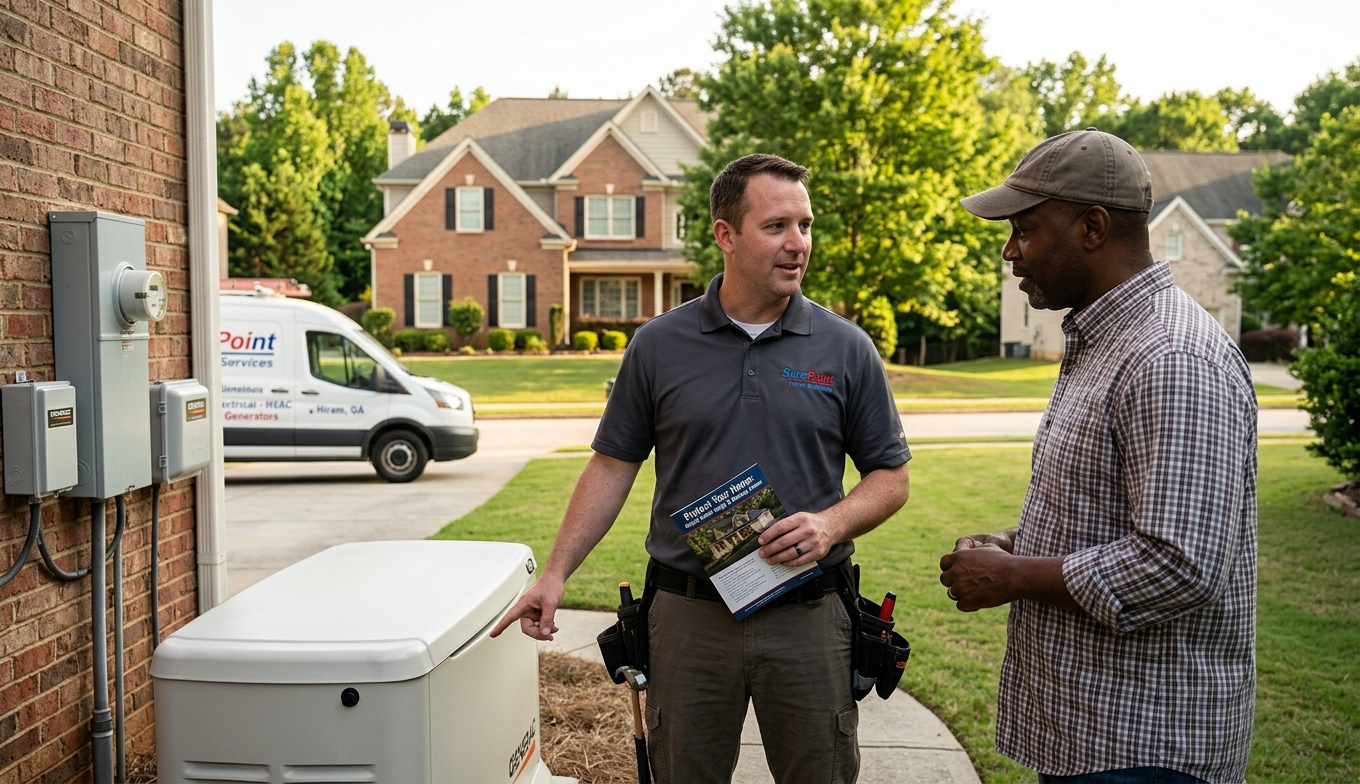
If you live in or around Hiram, Paulding County, or western Cobb County, you already know that our local power grid faces a brutal combination of elements. Between our massive, towering pine trees catching severe summer thunderstorms and the intense lightning strikes that rattle the US-278 corridor, keeping the lights on and your appliances safe is a constant battle.
As local residential electricians, one of the most common questions we get from homeowners off the Silver Comet Trail down to Nebo Road is: “Do I actually need a whole-home standby generator, or can I just get away with whole-home surge protection?”
It’s an excellent question, but it stems from a common misconception. Many people assume these two systems do the same job. They don’t. In fact, choosing the wrong one, or assuming one replaces the other, can result in thousands of dollars in fried control boards or hours spent sitting in a hot, dark house with a fridge full of spoiled food.
SurePoint Electric will unpack the truth about how these systems work, why they are entirely different lines of defense, and how to choose the right setup for your Georgia home.
The Core Difference: Blackouts vs. Voltage Spikes
To understand what your home needs, you have to look at the two distinct electrical threats facing your property:
-
The Complete Power Loss (Blackouts): This is when a tree limb takes down a primary distribution line on GreyStone Power’s or Georgia Power's grid. Your power goes down to zero volts and stays there for minutes, hours, or days.
-
The Transient Voltage Spike (Surges): This is a sudden, massive influx of electrical energy, sometimes thousands of volts, surging through your copper wiring for a microsecond. This can be caused externally by lightning striking a transformer box near your neighborhood, or internally when major appliances cycle on and off.
Here is how each system addresses these problems:
What a Whole-Home Standby Generator Does
A whole-home standby generator is your alternative power solution. It monitors the utility line coming from your outdoor electric meter. When the grid drops dead, an Automatic Transfer Switch (ATS) mechanically disconnects your home from the utility grid and fires up the generator engine. Within 10 to 15 seconds, your lights, HVAC system, well pumps, and refrigerator are running on continuous, clean auxiliary power.
-
What it solves: Prolonged power outages, lack of climate control, food spoilage, and loss of well water or sump pumps.
-
What it doesn’t do: It does not protect your home from an incoming high-voltage lightning strike.
What Whole-Home Surge Protection Does
A Whole-Home Surge Protective Device (SPD) is your electrical shield. Installed directly inside or adjacent to your main circuit breaker panel, it acts like a pressure-relief valve for electricity. When an abnormal voltage spike rushes into your panel, the SPD detects it instantly (in nanoseconds) and safely diverts that excess voltage down your home’s grounding electrode system before it can travel downstream to your outlets.
-
What it solves: It protects delicate microprocessors in your smart fridge, HVAC control boards, computers, and EV charging stations from being instantly fried or degraded over time by transient surges.
-
What it doesn’t do: It keeps your appliances safe, but it cannot keep your lights on. When the power goes out, you are still in the dark.
The Industry Secret: Why Generators Actually Require Surge Protection
Here is a technical truth block that most national blog posts completely leave out: If you invest in a whole-home standby generator, you absolutely must install whole-home surge protection alongside it.
When our crews are out installing a 22kW backup generator in Hiram, we always map out a complete protection strategy. Why? Because generators themselves are a frequent source of internal voltage surges.
When GreyStone Power drops out and your Automatic Transfer Switch (ATS) snaps over to bring the generator online, that sudden mechanical engagement creates an intense internal inductive kickback. Furthermore, as a generator engine throttles up and down to match heavy loads, like your 4-ton AC compressor kicking on, the temporary voltage fluctuations can stress sensitive electronics inside your home.
By installing a heavy-duty Type 1 or Type 2 Surge Protective Device directly at the electrical panel, you ensure that both incoming grid surges and internal generator switchover surges are instantly clamped down to safe levels (known as the clamping voltage).
Which Option is Right for Your Hiram Area Home?
Every household has unique priorities, budget constraints, and localized grid stability issues. Let’s break down exactly which solution aligns with your specific scenario.
Scenario A: You Only Need Whole-Home Surge Protection If...
-
Your budget is limited: A whole-home surge protector is an incredibly affordable, high-ROI investment that costs a small fraction of a standby generator.
-
Your power rarely goes out: If you live in a newer subdivision with underground utility lines where power is highly reliable, blackouts might not be a major concern for you.
-
Your primary goal is asset protection: You want to protect your expensive investment in home entertainment systems, smart home automation, ductless mini-splits, and high-end kitchen appliances from lightning capital damage.
Scenario B: You Need Both a Generator and Surge Protection If...
-
You work from home or rely on medical equipment: If losing internet connectivity, computers, or medical devices for even an hour is unacceptable, a standby generator is non-negotiable.
-
Your property relies on a well pump: If a storm knocks out power in Paulding County, homes on well water instantly lose their water pressure. A generator keeps your showers running and toilets flushing.
-
Your local grid is vulnerable: If you live in an area surrounded by older overhead lines and dense tree canopies where a heavy Georgia thunderstorm routinely knocks out the lights for hours at a time, a standby generator restores your quality of life.
The SurePoint Electric Approach
We don't just read about these systems in manuals; we service them every single week right here in your backyard. We’ve been called out to homes where a single lightning strike to a nearby pine tree traveled through the cable lines and melted every single GFCI outlet and smart appliance motherboard in the house. We have also seen homeowners install DIY portable generators incorrectly, creating dangerous backfeeding risks that threaten local utility lineworkers.
When you work with a locally owned, licensed team like SurePoint Electric, we don't apply cookie-cutter formulas. We look at your specific main electrical panel, evaluate your grounding system, which is critical because a surge protector cannot work without a properly installed grounding rod, and calculate your exact electrical load requirements to size your system perfectly.
Whether you want to safeguard your home's electronics with a premium Type 2 surge protective device or want the ultimate peace of mind that comes with a seamless Generac or Briggs & Stratton standby generator installation, we are here to provide honest, transparent, and expert craftsmanship.
Don’t Wait For the Next Major Atlanta Storm to Fnd Out if Your Home is Protected
Contact SurePoint Electric by calling (678) 951-5364 today to speak directly with a local expert electrician and request an on-site evaluation for your home in Hiram and surrounding communities. Or contact us online with any questions.