
Your NW Atlanta Area Home Electrical Safety Inspection Checklist
In March 2025, an EF-1 tornado touched down in Paulding County and knocked out power to 30,000 homes. Most of them right here in Dallas, GA. Three months earlier, Winter Storm Fern left Paulding County without power for days. This is the electrical storm-prep guide we wish every Dallas homeowner had read before those storms hit.
- 30,000 - Homes lost power, March 2025 tornado
What our electricians saw after this storm: Meters ripped from homes by falling trees, service entry cables shredded by limbs, main panels with water intrusion from roof and wall damage, and surge damage to appliances and electronics from the grid coming back online unevenly.
- 4+ days - Some outages lasted after Winter Storm Fern
What this storm proved: Homeowners with whole-home generators were warm, safe, and cooking while neighbors with empty firewood racks and dead phone batteries sat in 28°F houses. No other storm-prep investment has a higher return for Paulding County homeowners.
Why Paulding County Gets Hit Hard
If you've lived in Dallas, GA for more than a few years, you already know, storms here aren't a weather curiosity. They're a regular part of life. Paulding County sits in North Georgia's storm corridor . Close enough to the Atlanta metro to catch the worst supercell thunderstorms, and elevated enough to collect ice when temperatures drop into the low twenties.
Start With Your Electrical Panel
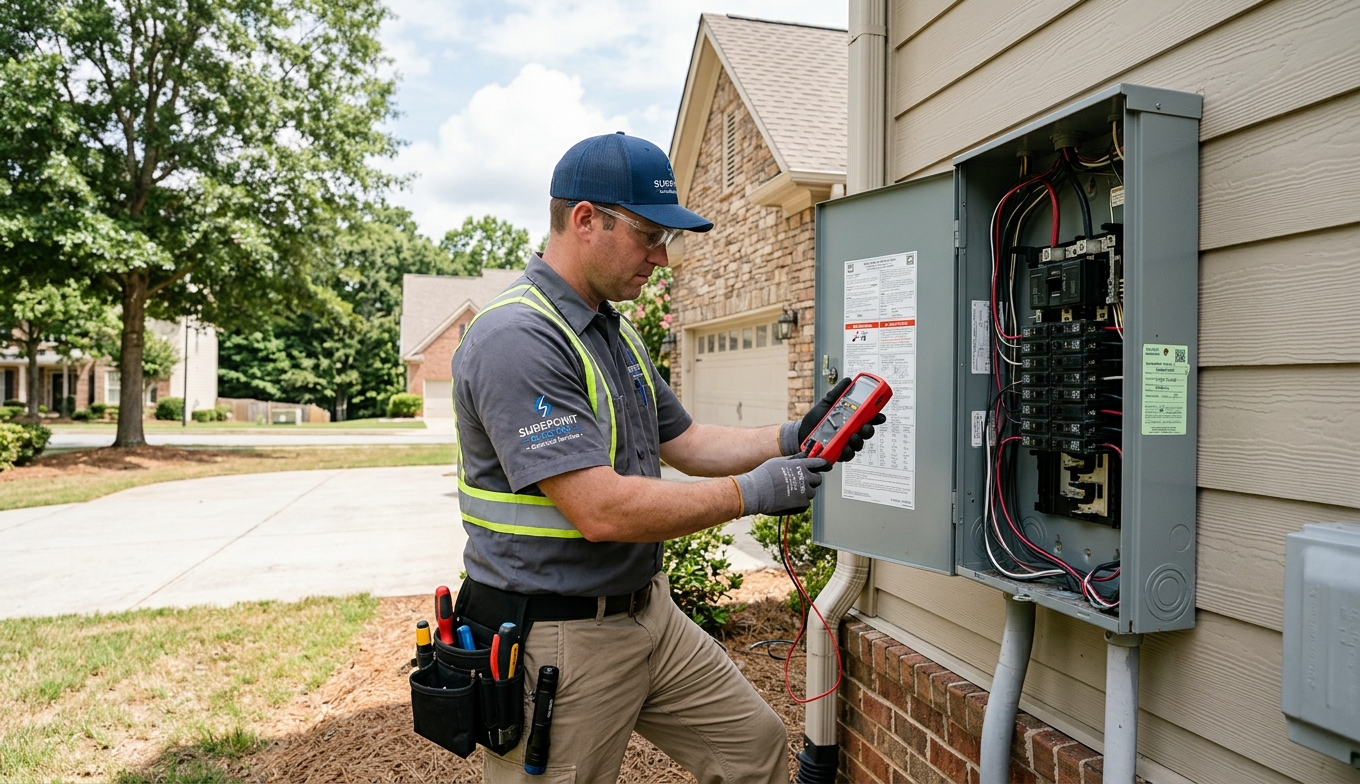
Your electrical panel is the central nervous system of your home's electrical system. In a storm, it's also the first thing that takes stress. Power surges as the grid fluctuates, branches falling on service lines, water intrusion if the storm is severe enough to damage your home's envelope. Before storm season, your panel deserves serious attention.
How Old is Your Panel?
A large portion of Dallas, GA's housing stock was built in the 1980s and 1990s which means many homes are now running on electrical panels that are 30 to 40 years old. Electrical panels are generally rated for 25–40 years of service life. An aging panel doesn't necessarily need immediate replacement, but it does need to be evaluated.
Some panels from that era have known safety problems that make them particularly dangerous during storm conditions.
Federal Pacific Electric (FPE) / Stab-Lok Panels — Serious Fire Hazard
FPE Stab-Lok panels were installed in millions of American homes from the 1950s through the 1980s. Independent testing has shown that Stab-Lok breakers fail to trip when they should, meaning during a power surge or overloaded circuit, the breaker doesn't shut off, and the wiring overheats. If your Dallas home has a panel labeled Federal Pacific or Stab-Lok, have it replaced before the next storm season begins.
Zinsco / GTE-Sylvania Panels — Similar Concern
Zinsco panels (also sold under the GTE-Sylvania name) have breaker designs prone to melting to the panel's bus bar, preventing the breaker from tripping. Like FPE panels, these were heavily installed during the 1970s and 1980s. If you find a Zinsco or GTE-Sylvania label inside your panel door, schedule an evaluation.
Signs Your Panel Needs Attention Before Storm Season
- Breakers that trip frequently under normal household load — running the dryer, the microwave, and the dishwasher simultaneously shouldn't trip your breaker
- A burning smell or discoloration near the panel, breakers, or anywhere on your walls near outlets
- The panel feels warm to the touch on the exterior cover
- You're running on 100-amp service in a home with an EV charger, two HVAC units, or a home office — modern loads often require 200-amp service
- Breakers that won't reset after tripping, or that trip immediately after being reset
- Any visible corrosion, rust, or evidence of water near or inside the panel
Before the Storm: Know Your Panel
Even if your panel is in great shape, make sure every adult in your household knows these three things:
- Where the main breaker is and how to shut it off. If a tree takes out your service line and your power goes out, Georgia Power or GreyStone will eventually restore the line — but if there's damage to your meter or entry cable, you need to be able to isolate your home from the restored power until an electrician inspects the damage.
- Which breaker controls which circuit. Most panels have labels inside the door. If yours doesn't — or if the labels are inaccurate (very common) — ask us to map your panel correctly during any service call.
- Never reset a tripped breaker without investigating why it tripped. After a storm, a breaker may have tripped because of actual damage to wiring. Resetting it blindly can be dangerous.
Get Your Panel Inspected Before Storm Season
SurePoint Electric offers electrical panel assessments for Dallas, GA and Paulding County homeowners. We'll tell you honestly whether your panel needs work and we'll never recommend replacement if it isn't necessary.
Call SurePoint Electric at (678) 951-5364 and get your panel inspected.
Whole-Home Surge Protection: The Single Best Investment You're Probably Not Making
Most homeowners think about surge protection in terms of power strips, that $25 strip under the TV with six outlets and a reset button. That's not surge protection. That's a convenience strip with a marketing claim. A direct lightning strike or a major grid surge will overwhelm a power strip instantly.
Real surge protection starts at the electrical panel.
What is Whole-home Surge Protection?
A whole-home surge protector (also called a Type 1 or Type 2 SPD — Surge Protective Device) is a device installed directly at your main electrical panel.
When a voltage spike hits your service entrance, from a nearby lightning strike, a utility switching event, or the grid coming back online unevenly after an outage, the whole-home SPD clamps the voltage before it reaches your home's wiring and connected devices.
It doesn't protect against a direct strike to your house (nothing does). But it protects against the far more common indirect strikes and utility-side surges that are responsible for the vast majority of surge damage to homes.
After the March 2025 tornado, we saw dozens of homeowners dealing with fried appliances, damaged EV chargers, and dead HVAC control boards. Damage that whole-home surge protection would have prevented for most of them.
A whole-home surge protector installed at your panel costs $300–$600 including parts and labor in the Dallas, GA area.
It's a one-time installation that protects everything in your home simultaneously. Run the numbers against replacing a single HVAC control board and the math is obvious.
Layered Surge Protection
The best approach is layered. A whole-home SPD at the panel for large surges, plus quality point-of-use surge protectors (real ones, rated in joules) for high-value electronics like computers, TVs, and home theaters. The panel-level device handles the major event; the point-of-use device handles smaller fluctuations that make it past the panel device.
Generators: Your Power Backup Plan for Paulding County
Winter Storm Fern was the clearest possible demonstration of why Paulding County homeowners need generator backup. Four days without power, in temperatures with wind chills near zero, in a home without heat. That's a medical emergency for elderly residents, a misery for families with young children, and a significant financial loss (spoiled food alone can cost hundreds of dollars).
There are two fundamentally different approaches to generator backup, and choosing the right one depends on your household's needs and budget.
Portable Generator
- Lower upfront cost ($800–$3,000)
- Manual startup: you must be home and act quickly
- Requires fuel storage (gasoline or propane)
- Can power selected appliances via extension cords or transfer switch
- Must be run outside only because of carbon monoxide risk
- Noisy during operation
- Good for: occasional outages, budget-conscious homeowners
Standby Generator (Recommended)
- Higher investment ($4,000–$12,000+ installed)
- Automatic startup which activates within seconds of an outage, even when you're not home
- Runs on natural gas or propane (no fuel runs during a storm)
- Connects to your home's electrical panel via a transfer switch
- Powers your entire home or selected circuits automatically
- Quieter than portable units; designed for multi-day use
- Good for: families, remote workers, homeowners with medical equipment, anyone who experienced the March 2025 outage and Winter Storm Fern
What Size Generator Does a Dallas, GA Home Need?
Generator sizing is not one-size-fits-all. The right size depends on your home's square footage, number of HVAC units, whether you have electric or gas appliances, and what you want to power during an outage.
As a general guide for Paulding County homes:
|
Home / Scenario |
Suggested Generator Size | What It Covers |
|---|---|---|
| 1,500–2,500 sq ft, one HVAC unit, gas appliances | 14–20 kW | HVAC, refrigerator, lights, outlets, well pump if applicable |
| 2,500–3,500 sq ft, one HVAC unit, mix of gas/electric | 20–22 kW | All of the above plus electric range or dryer circuits |
| 3,500+ sq ft, two HVAC units, all-electric | 22–26 kW | Whole-home coverage including multiple HVAC zones |
| Home with EV charger, pool pump, or well pump | Requires load calculation | A licensed electrician must assess your specific load profile |
Generator Installation in Paulding County Requires a Permit
The transfer switch connection to your electrical panel is permitted work under Paulding County's Building & Permitting Division. This isn't optional.
generator installations can void your homeowner's insurance and create liability issues if an incident occurs. SurePoint Electric handles all permit applications, inspection scheduling, and county sign-off as part of every generator installation in Dallas, GA.
Generator Safety — The Non-negotiables
Every year in Georgia, people die from carbon monoxide poisoning because of improperly used generators. These rules are not suggestions:
- Never run a generator inside your garage even with the door open. Carbon monoxide is odorless and deadly at concentrations that build up within minutes in an enclosed or semi-enclosed space.
- Minimum 20 feet from any window, door, or vent when operating a portable generator. Carbon monoxide can re-enter your home even from that distance in the wrong wind conditions.
- Never backfeed power into your home by plugging a generator into a wall outlet (called "suicide feeding" or "backfeed"). This is a code violation, a serious fire hazard to your home, and a genuine threat to utility workers restoring power in your neighborhood. Use a properly installed transfer switch.
- Test your standby generator monthly. Most standby generators have an automatic weekly exercise cycle built in. Confirm it's running during those cycles. A generator you haven't tested in two years may not start when you need it.
EV Chargers and Storm Safety in Paulding County
With thousands of new homes going up in Paulding County every year and median household incomes well above the national average, Dallas, GA has one of the fastest-growing EV adoption rates in metro Atlanta. If you have a Level 2 home charger installed, or if you're planning to install one, you need to know how storms interact with EV charging infrastructure.
Before a Storm: Stop Charging
When a severe thunderstorm warning or tornado warning is issued for Paulding County, stop charging your EV. Unplug the charging cable from the vehicle. If you can safely reach the outlet without going outside into the storm, unplug the charger from the wall as well.
A nearby lightning strike can send a transient voltage spike through your utility line that overwhelms even quality chargers. Your vehicle's onboard charging module, the component that converts AC wall power to DC for the battery, is particularly vulnerable. Replacing an onboard charger module can cost $1,500–$4,000 depending on your vehicle make and model.
Whole-home Surge Protection and Your EV Charger
A whole-home surge protector at your electrical panel provides meaningful protection for your EV charger when you can't manually unplug it. The panel-level device clamps large transient spikes before they reach your charger's circuit. This is the best combination: surge protection at the panel plus the habit of unplugging before severe weather.
After an Outage: Don't Rush Back to Charging
When power is restored after a multi-hour outage, the grid doesn't come back at perfectly stable voltage instantly. There can be brief overvoltage conditions as the utility re-energizes lines and demand normalizes. Good Level 2 chargers have built-in protection against this, but giving it 15–20 minutes before beginning a charge session after power restoration is a reasonable precaution.
Georgia Power EV Charger Rebate is Still Available in 2026
Georgia Power residential customers are currently eligible for up to a $150 rebate on qualifying Level 2 EV charger installation. The federal Alternative Fuel Vehicle Refueling Property Credit (30% of installation costs, capped at $1,000) is available for qualifying charger installations placed in service through June 30, 2026. If you haven't installed a Level 2 charger yet, the window to combine both incentives is closing.
Contact SurePoint Electric at (678) 951-5364 for details on current programs.
EV Charging During a Power Outage
This question comes up after every major Paulding County outage: "Can I use my EV battery to power my house?"
Some vehicles, most notably the Ford F-150 Lightning and certain configurations of the Rivian R1T, have bidirectional charging capability (V2H or V2G) that can power home circuits during an outage. Most EVs do not.
Check your specific vehicle's documentation before assuming this capability exists, and note that V2H capability typically requires a special transfer switch installation.
During the Storm: What to Do and Not Do
When a tornado warning or severe thunderstorm warning is active for Paulding County, your primary job is to get your family to a safe location. A basement, an interior room on the lowest level, away from windows. Electrical preparedness during a storm is mostly about avoiding mistakes rather than taking action.
What To Do
- Unplug high-value electronics and your EV charger as soon as severe weather conditions begin. Before the storm is on top of you.
- Stop running major appliances like the dishwasher, washing machine, and dryer before the storm arrives.
- Keep your refrigerator and freezer closed. A fully stocked, closed refrigerator maintains safe food temperature for approximately four hours without power. A full freezer holds for 24–48 hours. Don't open them unnecessarily during an outage.
- Keep phone chargers plugged in and phones charged until the storm is imminent. Once you lose power you'll want that battery level
What Not To Do
- Do not go outside to inspect damage while the storm is still active. A downed power line in standing water is lethal.
- Do not touch any downed power lines, ever, under any circumstances. Even if the line appears dead, assume it's energized. Stay at least 30 feet away and call 911 and your utility company immediately.
- Do not use candles near your electrical panel, near any areas of storm damage, or in rooms where water may have entered the home.
- Do not start a portable generator indoors or in the garage, not even with the garage door open. We cannot overstate this: carbon monoxide poisoning is the leading cause of non-injury storm fatalities in Georgia.
- Do not attempt to reset tripped breakers until the storm has passed and you can inspect for damage.
Ready to Storm-Proof Your Home's Electrical System?
Whole-home surge protection, generator installation, panel inspection, EV charger safety. SurePoint Electric handles all of it for Dallas, GA and Paulding County homeowners.
- Locally based neighborhoods from Dallas to Atlanat, Marietta and Alphraetta
- Available 24/7
- GA Licensed ER102453